Zoltán Bényei - Zoltán Gurály -
Péter Győri - György Mezei
After Ten Years
Report on the Homeless in Budapest - 1999
❧
Homelessness in Europe
International Conference
Hajszolt
Balatonföldvár - Hungary 28-30. October 1999
We made a survey-sheet of fifteen questions, and, on an average winter evening (Wednesday, 03 February 1999, between 5 p.m. and midnight), when the average temperature of the day was -5 C, we asked those staying at homeless hostels and night shelters to fill in. At that night there were 52 homeless hostels and night shelters open in the capital, capable of accommodating 3,228 people altogether. Out of these, three institutions (capable of accommodating 307 people altogether) refused to participate in the survey. The remaining 2,921 beds were taken by 2,773 people that night, which means a 95% of accommodation capacity. It was 90% of those we had asked that answered the questions of the survey sheet (however, concerning certain questions a lack of data occurred), which means that we could treat the answers of 2,552 persons. Simultaneously (after 6 p.m.) the services dispensing hot tea and sandwiches in public spaces, within the framework of the "winter crisis action", also asked the 360 people using the service some of these questions.[1] It was the social workers of the different institutions who made the survey, after having been previously prepared for the job. Let us thank them for their work here as well.[2]
One of the aims of the inquiry was to acquire a clear-cut, easy-to-survey "snapshot" of those using the provision services for the homeless at a given time[3], while the other aim was to start such a way of gathering information which can be repeated each year and so it makes it possible to compare those using the provisions as regards time and tracing the tendencies of changes - in order that the system of provision can be continuously evaluated and developed accordingly.
In our analysis we first of all try again to make clear, with self-criticism, the fundamental conceptions and try to find an explanation for why have the use of them become distorted over the past ten years and also, what distortions have all this resulted in in shaping provision strategies. We corroborate our statements with data of empirical assessment, and then refine them by the small sample analysis of presenting the typical ways of becoming homeless. Next, we examine if those who had become homeless last year are different from those who had been homeless since a longer time or not. Then we compare the different means of provision according to the main characteristics of those using them and, finally, we survey who are those who, at the same time, staying in the streets of the capital, had used the so-called tea-service.
At the end of our paper we will sum up the basic conclusions we could reach considering some of the disfunctions of the system for the provision of the homeless, laying an emphasis on the problem of to what extent do the institutions providing shelter serve the needs of the homeless, flatless, effective homeless and roofless, what essential differences can be observed between institutional aims and actual use, and where can the major contradictions between the services of the different types of institutions for the provision of the homeless be revealed. We try to phrase a few initiating ideas regarding the possible directions of the necessary changes, in the hope of promoting further consideration and action of those engaged in this field.
Both in phrasing our conclusions and in elucidating the conceptions we tried to adhere to the correct analysis of the empirical surveying as strictly as possible. This is, of course, also something that marks out the limits of our present survey as well: "after ten years" we concentrated rather on the real data then the analysis of our own temporal impressions of those ten years. Analysing the data of this survey done in the capital can obviously not be a basis for substantially analyse why the system for the provision for the homeless in Hungary, together with the related system of regulations, financing and the mentality of those professionally involved do not even "have a nodding acquaintance" with handling the tragic situation of several thousands of such people who, as a result of natural catastrophes or acts of distraining had to experience in 1999 that they had become roofless.
Trap of Words - Trap of Numbers
"Are there homeless people in Hungary?" was a question asked by the journalists in 1988-89, during the period of the criticism and the change of the regime. Much water had flown under the bridges since then, and the answer: "Yes, in Hungary there are homeless people" had undergone a lot of exchange of messages both politically and in its meaning, content. By now, public mind uses the word "homeless" , with which it was confronted ten years ago, as a commonplace though at that time even using the word, recognising the presence of homelessness became a political element.[4] There were several questions asked and answers heard about "Who are the homeless and how many they are?", and a number of part studies had been written on the question since then.[5]
After ten years we judge that very often inaccurate answers were given to inaccurate questions, lots of times serving actual and partial aims. It may be even more important that, as a result, the notion of homelessness as a social phenomenon had also became distorted, and so the strategies for the provision for the homeless became distorted on the same basis. This is what we try to prove later on in this paper. Besides the publicists, forming public opinion, and the decision-making politicians we, "the professionals" ourselves as well had our role in all this, so it is time for us to face the responsibility and the burden.
During the period of the criticism of the previous regime and later on during the years of the new one, including the shaping of the system of provision for the aiding of the outcast we laid a dominant emphasis on the structural and social reasons, factors and processes generating and conserving homelessness.
Meanwhile, the more subtle decisive factors influencing personal careers had fallen into the background - though they could be physically experienced day by day. Besides the undeniable veracity of this approach, several other things have played a role in such a shaping of the professional wording. It is simpler and easier to understand, and it is easier for the political and everyday language to manage if we talk about closing up workers' hostels or the appearance of unemployment than if we would speak about childhood abuse and mistreatment, the spiritual force of upholding the personality or complicated failures, crashes of social mobility. We were of the opinion - and still are - that it was this simplified wording that was necessary for decisions to be made, for a genuinely new system of provision would be created. On the other hand, we are also of the opinion that - at least among the professionals - it is high time for a more differentiated way of thinking and terminology to spread which, on the long run, will lead up to a correction and an adaptable improvement of the distortions of the system of provision that had developed so far.
One of the reasons of this wording was - and still is - that we would like to protect the outcast from the subjectivised stigma of "one's own fault" verbally as well, an such a protection, in the quite complicated sphere of analysing individual fates is far from being promising.[6] We have been afraid, and still are, that we cannot word in an easily apprehensible way the contradiction of the deep and inseparable relation of human reprobation, being deprived and dispossessed, lack of basic needs and the observed, threatening mental processes, anomic conditions, "social loneliness". And if we cannot explain this properly, we unwillingly will enhance uncertainty and superficial prejudices.
Professionals involved had been continuously struggling with this problem, but they could not, as they did not have the chance to articulate this dilemma. However, the professional responsibility of those working in the system of provision, social management and last, but not least the competent analysts cannot end at this stage as - at least according to our opinion - in that case the ways and forms of provision itself would be distorted as well.
Moreover, simplified wording had become a source of a number of unproductive debates within the professionals involved, increasing uncertainty - strange enough - due to the lack of a radical re-wording of fundamental conceptions, leading up to and together with drafting the relevant tasks. We hope that a more differentiated approach can contribute to help us avoid getting on the wrong track, realise if we are deadlocked, and have more fruitful polemics in the future.
It is also related to the above that we have not so far been able to create a satisfactorily differentiated picture of the state of homelessness itself as a social phenomenon. The most startling problem in this respect may be that the relationship of being (effective) homeless and flatless is not elucidated.
Let us again refer to the fact that, before 1948, in the official use of the word "homeless" not only meant those who lived in hostels, shelters or in public places, but also included the "flatless". Presently, in the European/English-speaking usage the word "homeless" implies even more: beyond the above also those, who live in an overcrowded flat, below acceptable level. As opposed to this, in our country, after the change of the regime, the word "homeless" appeared primarily as a humanised version for "vagabonds", "tramps", "roofless".[7] According to our view, the distortion of this usage of the words also had marked reasons. Namely, that, in the years after the change of the regime, the attention of both public opinion and politics/policies were stirred up primarily by the extreme, obvious, mass, openly appearing forms of homelessness, for the "managing" of which there was a hope for, applying temporary, "fire extinguishing" methods. Narrow possibilities, means and resources seemed to have been attainable, while the forms of homelessness appearing in the form of flatlessness, together with the fact that these were unsolved, were surrounded by turning away, non-acknowledgement, scepticism and incapacity.[8]
It is high time for re-examining not only the reasons, but also the results of this distortion in the use of definitions, in order that we can not only properly understand the nature and the facts of homelessness but also handle, manage it and the related the problems.
Finally, we also should not leave aside, leave unobserved the meaning-content of the word "homeless" among those involved. It was before the change of the regime, in the period of the criticism of it, when that meaning of this word evolved, which differentiated the "self-conscious homeless" from the "vagabonds taking shelter here and there" and the young "saunterers" and "submergers". The "self-conscious homeless" tried to join hands, demonstrate, fight for their rights and better chances. There has also been a period of this "beginning to feel one's feet" of the homeless at the time of the change of the regime when the "homeless" tried to act as an individual, self-organised group, a community. This meant for the supporting professionals of provision that they had to face the challenge whether they would support, back, strengthen these self-making communities or they would try to drive these initiatives into that framework which might become a new social aiding system accomplishing reform ideas compared to the past ones, together with the relevant new institutions to be created.[9] (The supporting professionals had chosen the latter, and we cannot know up to the present what would have happened if...)[10]
It is also a result of this that it took not too much time for the "self-conscious homeless" to become users, clients, protégés of the system for the provision for the homeless while, within this circle, newer and newer groups appeared continuously. In the course of defining one's own situation the borderlines had become more and more vague when one was asked to say if he considered himself or his fellow(s) homeless, or not to be homeless "only" a vagabond, or not yet/already not homeless, but just flatless. However, despite of the fact of the above-mentioned borderlines having become vague, the distinctions and the importance of them had very well remained for those concerned. Considering all the above, we do not think too much more has to be said to give an idea of the following: if even trying to label and name the different ways and types of homelessness we come up against so many contradictions in the use of words and in elucidating their exact meaning, how "brave" abstractions would we need to try to estimate the number of the "homeless"? Besides the often-mentioned problems of recording and mustering we have to underline here that, in case we cannot reliably define who do we consider to be homeless at all, even the estimation of the number of those concerned is unacceptably uncertain. However, we have to accentuate on a question which we regularly encounter, namely, that we have to differentiate between the number of those who, at a given time (a specific day or night), were staying under the open sky or in night shelters (or were in a similar situation) and the number of those who, in a given period (e.g. in the space of a year), had turned up at the same places, having got themselves in such a state. Considering a given period, the number of the latter - regarding the "rate of rotation" of getting in and out - can be a lot more than of those, who are in such a situation "right now".
Considering all the above as a basis, re-defining certain definitions may be of a great help in further orientation. Accordingly:
1. We consider "roofless" those, who:
- spend their nights in a public place, under the open sky, or in an obscure place not suitable for habitation
2. We consider "effective homeless" those, who are:
- "roofless", or
- who do not have a stable, permanent dwelling, and have to "work for it" day by day to have a place to spend the night - it can be either a flat, providing accommodation as a favour, or some other place, not a flat, but a suitable dwelling (one of the institutions for the provision for the homeless, as an example)
3. We consider "flatless" those, who are:
- "roofless", or
- "effective homeless", or
- who have a stable dwelling which is not a flat but is suitable to live in (hostels for factory workers, jails, inhabitations, etc.), or
- who have a permanent place to spend their nights in, but they are not in the disposal of the unintermitted use of the flat (they are not owners or tenants but lodgers, sub-tenants, night-lodgers, grown up family members, having been accommodation as a favour or just having been given shelter to)
4. We consider "homeless" (or "being periled by becoming homeless") collectively those, who are:
- "roofless", or
- "effective homeless", or
- "flatless", or
- who live in a flat, but it is not suitable for creating a real home and raising family in (either because the flat is overcrowded or because of the physical conditions of the flat/building)[11]
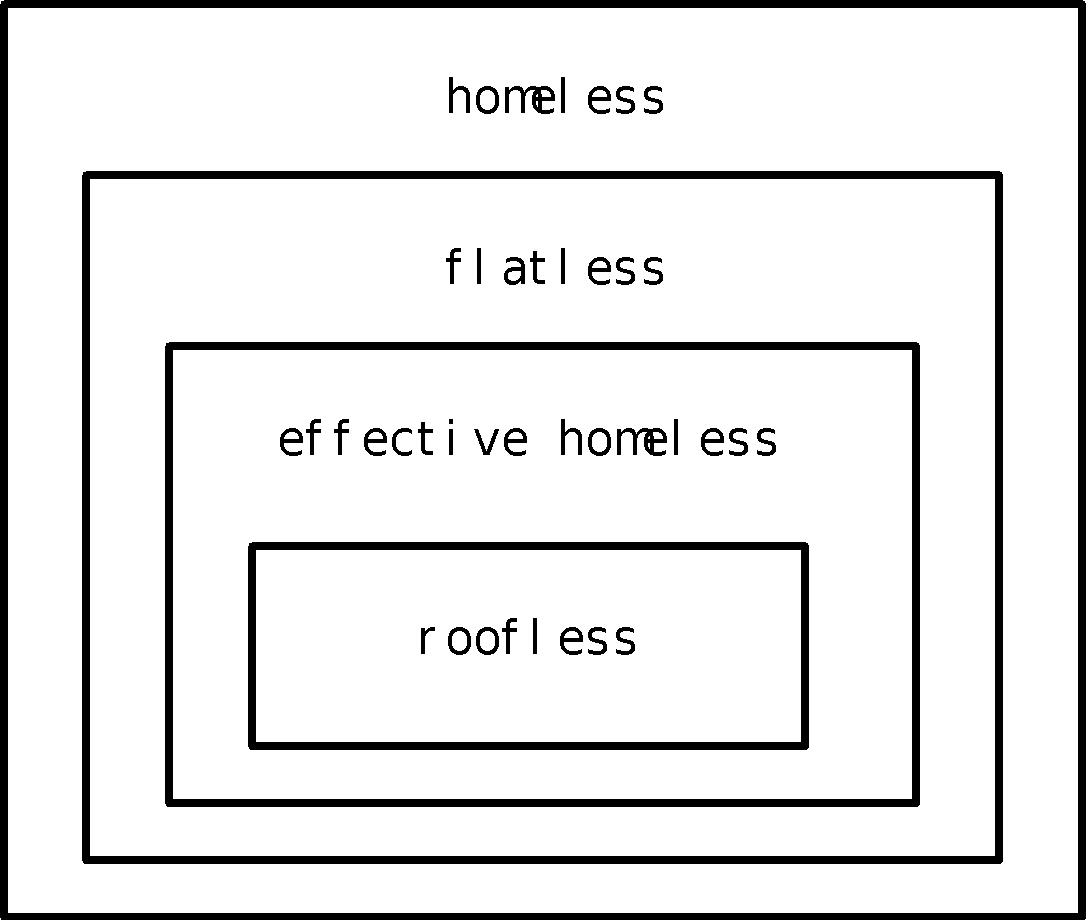
We have the following statements:
* Homelessness is such a way of life, and also the complex of social and personal relationships, within which the above outlined situations succeed one another. On the other hand, changes between the different stages can be quite frequent, as these, besides personal reasons and individual careers, also depend on the social and institutional strategies affecting the effective homeless or those who are in the danger of becoming homeless.
* In the course of the changing conditions of their lives, people themselves experience their state subjectively, and so they identify their stage of being "homeless" accordingly: some consider themselves "homeless" when they become actually roofless, others when they have no other resort than a night-shelter, or when they have just lost their secure dwelling, or when they cannot find their own place in their overcrowded "flats" not fit to live in.
* The so-called network of institutions for the provision for the homeless is pronouncedly one (but not the only) stage of these changes in one's dwelling possibilities: the circle of homeless in a wider sense is a lot wider than that of those using the provision system at a given time and, at the same time, among those using the provision system at a given time we find both ones who used to be and ones who will be in the above-mentioned situations for shorter or longer periods.
Roofless - homeless - flatless - on the basis of the survey
In the course of the survey we asked the usual question: "Since when have you been homeless?" At the same time, we also asked: "When was it last time you lived in a flat?" When we compared the answers we found that half of those asked (51%) dated the two for the same time (counted in months). Part of the rest said that they lost their flat earlier and dated their "becoming homeless" to a later time (29%), while the other part said that they had "become homeless" earlier, but after that there were times when they lived in a flat in one way or another (20%). Furthermore, there is a great difference concerning the time of having become homeless between the groups that can be differentiated according to the above. Those, who date their having become homeless earlier than the last time they lived in a flat have averagely been "homeless" for 81 months, those who said that the two coincided are averagely homeless for 63 months, while those who date their having become homeless later than last time living in a flat are averagely homeless for 46 months. This suggests that there were no incidental mistakes when answering the questions of the survey. That is, part of those who were asked date their own having become homeless to the time when they lost their independent flat, becoming actually flatless, another part does not consider himself homeless even being flatless, and the third part feels to be homeless (or leads a life as if he would be one) even when he is spending the nights in a flat.
We have also asked the question "Where have you been living (sleeping) a year ago?", looking back from the time of the survey. Based on the answers received, we discovered the following.
Those who... | have... |
Those who have lived in the street, "roofless", 6% altogether | have been homeless for more than one year almost without exception |
Those having slept in institutions of provision, as "effective homeless" (63%) | have regarded themselves to have been homeless before that, too (98%) |
The "flatless", living in other institutions than those for provision or in accommodation as a favour (25%) | the majority (58%) regarded himself homeless in the earlier period, too, the other part considers himself to have become homeless only later |
Those who lived in a flat in any form (own, or as a favour) (24%) | 57% had "become homeless" within a year, 43% more than a year |
Those who used to live in a flat of their own (6%) | the majority (74%) had become homeless within a year, the rest (26%) had lived as a homeless already earlier |
The above confirms that there are certain forms of accommodation - primarily the so-called accommodation as a favour - which are a sort of intermediate state, and this is the reason of the uncertainty which appears in the answers given to the question "Since when have you been homeless?", in the self-definition of those who are in such a situation. Or, in other words, flatlessness is in fact an intermediate situation between effective homelessness and homelessness, and it is variable at which stage does one consider himself to be homeless within this period.
To the question "What is the reason for your having recourse to institutions for the provision for the homeless?" we have received the following answers. Two thirds of those using the homeless hostels and shelters mentioned personal problems (divorce, having been driven out), one fifth a problem directly related to residence (he was evicted, his under-tenancy was terminated, his flat had become uninhabitable or he has sold it), and every seventh named a so-called economic - institutional reason (namely, that he was released from hospital, state care or jail, or he came to Budapest to try to find employment). As we will see later on, we have all reasons to presume that the majority of the largest group, naming personal (family) problems as a reason, does not directly get out into the street or into night shelters. They first try to stay within the world of digs, flats of relatives, friends or as a favour for shorter or longer periods, and it is only after that that they have recourse to institutional help. However, they identify the reason, origin, source, beginning of their having become homeless in the fundamental cause bringing about their come-down. However, we can phrase it in a different way as well: though the major outward aspect of homelessness is flatlessness, flatlessness itself is not the major reason leading to homelessness. This fact also indicates that this problem is a multi-dimensional one in its content as well, which means that managing it requires a more complex treatment beyond the temporary aiding of provisions for dwelling.
Paths of life of the homeless - based on a small-sample survey[12]
The "questionnaire" worked out for the whole network for the provision for the homeless in the capital cannot take us further than finding out where had those using the provisions come from, so wit the help of it we cannot answer the questions what had the paths of lives of the presently homeless had been, how and from what situations did they end up being homeless. Therefore, in order that we can control the validity of our assumptions, we had a recent, small-sample survey to our help, comprising the answers of 96 such persons who were staying at homeless' hostels and have said to have become homeless within a year.[13] We have asked them the question "What sort of a dwelling had you been living in before you have become homeless?" Based on the answers we were given, we assume the following. We consider "losers of a flat" who started their "homeless-career" who lost their privately owned flat or their tenancy was terminated (23% of those asked). We consider "flatless" those, whose latest dwelling was not of his own: he was a sub-tenant, lived in a workers' hostel, lived in a flat as a relative, or as a favour (77% of those asked). This means that within the twelve months before the survey more than three times as many people coming from a "flatless" situation ended up in a homeless' hostel than those coming from their own dwellings. More than half of those in the homeless' hostels had never had a dwelling of their own. (About three quarters of the flatless had never had a flat of their own since they reached their adult age[14]. In the cases of a few (5%) we know it for sure that flatlessness in their case is already a stage of come-down, as they used to have a flat of their own.[15]
Concerning the last dwelling
On an average, those "losing their flats" moved into their dwelling at around 1989-90 and lost it after averagely 9 years, in 1997-98. The "flatless" averagely have lived for half the time, 4.5 years (since 1993-94) in their last dwelling.
As far as the crowdedness of the dwellings of those "losing their flats" is considered, we find that one fifth of the had lost definitely favourable conditions (over 30m2/person), and more than two-thirds came from a medium-crowded flat (10-29m2/person). We considered wretched crowdedness if in a flat there was less than 10m2/person - less than one tenth came from such flats. According to the provisions of law presently in force ordain to ensure a minimum living space of 6m2/per person in a homeless' hostel. It was only 2% of the dwellers of the hostels who came from a more cramped dwelling than that.
If we consider the number of persons sharing a room in the last dwelling, we find the following. Two-fifth had a room on his own, another two-fifth shared a room with another one and only about one-seventh had lived more cramped in one room. In the case of those who had lost their own flat the situation was even better. Summing up we can also say that it is in the case of only every seventh homeless when we can suppose that the flat being too cramped might also have been a reason in the beginning of the "homeless-career".
From the flat to the shelter
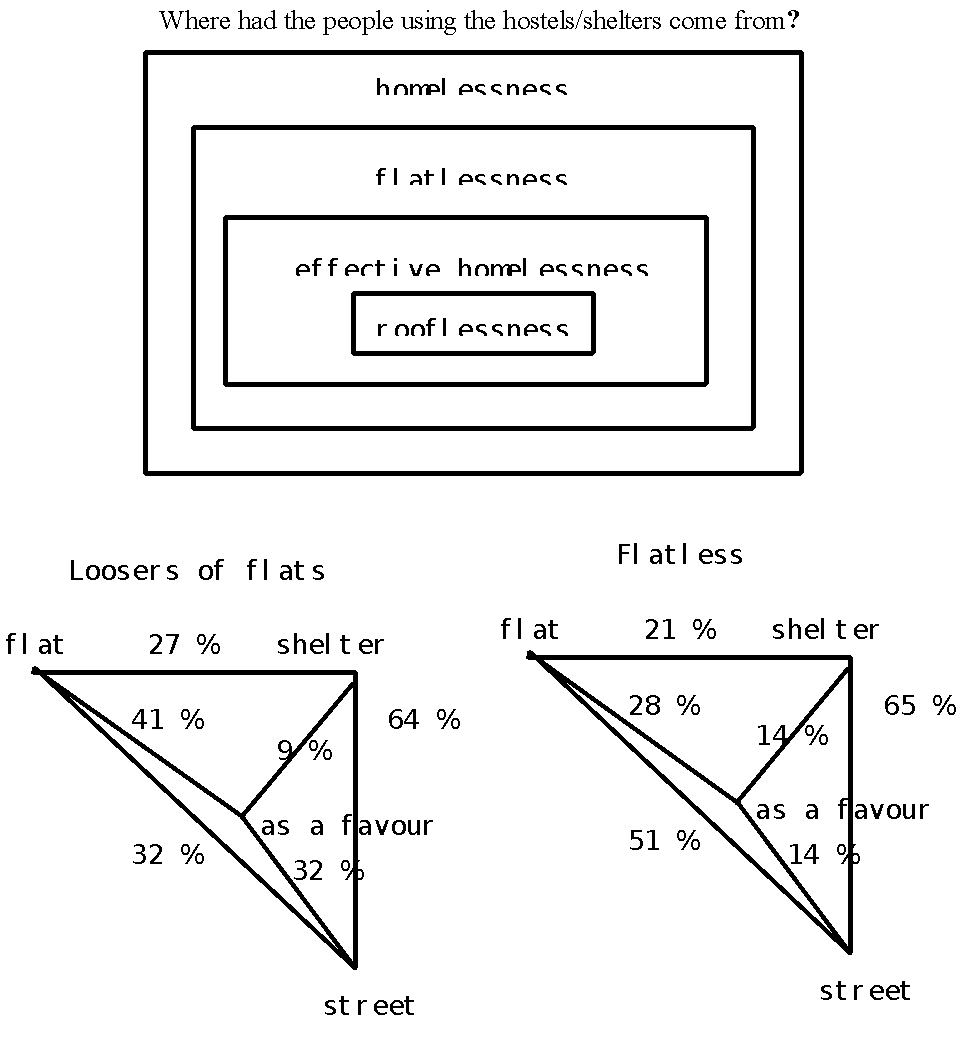
Both the flatless and those who have lost their flats do the same four typical ways, though it is true that the proportions an the span of time are different.
The four ways are the following:
1. From a flat - to a shelter
2. From a flat - to the street - to a shelter
3. From a flat - to an accomodation as a favour - to a shelter
4. From a flat - to an accomodation as a favour - to the street - to a shelter
Those who had lost their flat | The flatless | Altogether | ||||
% | number of days | % | number of days | % added up | number of days | |
flat - shelter | 27 | 0 | 21 | 0 | 23 | 0 |
flat - favour -shelter | 9 | 12 | 14 | 46 | 12 | 40 |
flat - street -shelter | 32 | 22 | 51 | 18 | 47 | 19 |
flat - favour - street - shelter | 32 | 29 | 14 | 47 | 18 | 40 |
Added up | 100 | 25 | 100 | 24 | 100 | 24 |
It is only less than a quarter of those who from their flat directly go to a hostel or shelter - almost two thirds spend a shorter or longer period before that in the street or other public places as roofless.
We have also noted a difference in the way how the flatless and those who had lost their flats arrive at the hostels/shelters. As for the latter, somewhat more of them go directly to hostels/shelters, a lot more of them can get accomodation as a favour (though for a shorter time)[17], and two-thirds of them spend some time out in the street before they go to hostels/shelters - normally a lot longer time than the flatless.
For those we had asked in our survey it had generally taken a little bit more than three weeks (23 days on average) to get to one of the social service points after they had lost their flat. This period is the longest for those who are "going through" the complete way of homelessness: before getting into a hostel/shelter they stay in accomodations as a favour and also out in the street or public places - for them it averagely takes a little less than two months to get to one of
the hostels/shelters. On the average they manage to spend in accomodation for favour more
than five weeks (40 days), while living out in the street is less than a half of this time (16 days). However, comparing the average time spent in accomodation as a favour or out in the street with those of the flatless, we find the same thing: it seems that those who had lost their flat are "less practiced" in the world of the homeless, whereas the flatless are more "practiced" in changing between the different, uncertain types of dwellings.[18]
Reasons of becoming homeless - atrocities at home, in the street and in the hostels/shelters
In our surveys we have found that personal conflicts play a prominent role among the direct reasons of becoming homeless, and this fact has also been reinforced by the ones we have asked. About half of these conflicts are brought about by passions - alcohol, sex, drugs, gambling.[19]20 The majority of personal conflicts is basically constituted of the criticism of the attitude to work and the aversion of the spouse and his/her relatives put into words in a general way. The intensity of the relationship between becoming homeless and personal conflicts is well demonstrated by the fact that 43% of those asked put atrocities at home to the first place among the reasons. The street is "only" on the second place - almost a quarter of those asked had suffered some kind of abuse, ill-treatment in the street. Those living in the street or public places quite often mention that they do not use the shelters because they are afraid of being abused or ill-treated there. (On the other hand, half of those using the shelters are also afraid of being exposed to some sort of atrocity.) Compared to this, only 4% of the shelter-dwellers that had been asked mentioned concretely that they had suffered abuse or ill-treatment.[20]21
What steps have you taken to change your status of being homeless?
40% f those who have "lost" their flat still have concrete ideas of how to solve their problems when they have to move out. They are convinced that they will get straight, they will search for and find a job and a room for rent, and will settle their lives. We have asked them what efforts they had made to avoid becoming homeless: have they tried to find a job, earn money, find a place for their personal belongings. At all: did they inform any of their close acquaintances about their trouble? On third of those asked could not alert any of his acquaintances in his situation which may as well be called extreme. Four fifth of those who have tried to "mobilise" their acquaintances managed to turn to one or two. Most of those they contacted were friends, rather than family members or other relatives. We have also asked if later on they had tried to return to their earlier dwelling or not. More than one third tried to do so, and among these the number of those who had practically no relations when they had to leave their dwelling was twice the number of those who had some sort of helpful contact.
We had a separate set of questions inquiring about whether or not they could count upon the help of some non-homeless people in filling their physiological needs (meals and drinks, dejection, personal hygiene, sex, changing of clothes, washing). The majority of those asked (63%) could not mention a single contact of this kind. Half of those who had such contacts had a possibility to satisfy only 1 or 2 of the above-mentioned seven basic needs. For the majority of them homelessness means both losing their contacts and their basic needs being left unsatisfied more and more often, at the same time.[21]22
The "new" dwellers of hostels/shelters - the 1998 "generation"
Coming back to the results of the February 1999 survey of the homeless in the capital we first try to examine if the characteristics of those who have become homeless within a year (the "new" homeless) are different from those of the others or not. We have two reasons to find it important to go deeper into this question. On the one hand, the "new" being different may forecast certain tendencies of change, though this can only be confirmed if the survey is done regularly, each year. On the other hand, there may be some among the "new" there may be ones who are/will be homeless only for a shorter period and it is important and interesting to find out the differences between them and the others.
Where have those come from who answered that they had become homeless within the last twelve months? A decisive majority of them (85%) had still been living in a flat in February 1998.[22]23
Though they said to have been living in a flat, it is only one quarter of them who had a flat of their own - they are the ones that became "losers of their flat". The majority (59%) was flatless already a year ago, which means that they were living in digs, in accommodation for a favour or as family-members.
Age distribution
Both earlier surveys concerning the homeless and the one made in February 1999 revealed that the majority (55%) is middle-aged, between 30 and 49. This proportion is higher than the proportion of the same age-group in the total Hungarian population (36.5%). Half of the "new" homeless (51%) too, belongs to this age-group but the proportion of those above sixty is hardly more than half (6%) of the number of those above sixty within all the registered homeless (11%). Also, this proportion is only on third of that of those of over sixty in the total population (19%). It is also to be noted here that, when considering the old in the total population we find that the great majority are women, whereas among the same age-group of the homeless the proportion of women is a lot less. Among those who had become homeless within a year the proportion of women is a lot higher (27%) than in the total group of the homeless (19%).[23]24
Educational level
It had been an often quoted formula that, contrary to public opinion, the homeless are not in the least coming from the poorest and least educated layers of society. For the age-group above 40 this is really true, both considering vocational training, high-school diplomas and college/university diplomas. However, a great difference in this appears regarding the age-group of those below 30 who had become homeless and found themselves in homeless' hostels or night shelters. Among the homeless younger than 30 the proportion of those who have some vocational training or a high-school diploma is far behind that of the same age-group of the total Hungarian population. If we consider the age-group younger than 30 among those who became homeless in the past year we find another special occurrence: among them there are twice as many of those who have finished only their 8-class primary-school education (or have not even finished it) as among those of the same age-groups who had become homeless earlier.
Ability to work - income
About a quarter of those living in homeless' hostels or night shelters vegetate without any regular income. Within the group of the "new" homeless this proportion is not much (only 3%) higher. The proportion of those capable of work is higher among those who became homeless in the past one year (77%, and 66% among those asked)[24]25. It is obviously related to this fact as well that the proportion of those getting wages regularly is higher (44%, and 37% among those interviewed) and, on the other hand, a lot less of them receive some sort of provision from the National Health Service or subsidies (28%, and 39% of those interviewed).
Summing up we can say that among the people living in homeless' hostels the group of those who became homeless within the past twelve months are generally younger, more capable of work, more of them have regular wages and the proportion of women is higher. On the other hand, however, their level of education, the reasons of having become homeless, their loneliness, background/birthplace does not really differ from those of the others. What is more, they fall into line in the system for provision in the same proportion as the others do (contrary to some presumptions, their proportion in the night shelters is not higher than that of their fellows. However, we cannot presently answer the question whether this fact is to indicate that the 1998 "generation" is basically of the same social composition as the previous ones, or it indicates that the "new" homeless and the "old" do not basically differ from one another considering these aspects.
Homeless' hostels and night shelters; operated by local authorities or NGOs
A comparative survey of those using the different types of institutions
Though with some distortions, the institutions involved in the 3 February 1999 survey reflect the basic different types of the hostels/shelters for the provision for the homeless in Budapest.[25]26 In the following we will examine the major disparities concerning those using the temporary hostels and the night shelters found by this survey which was intended to be a full-range one.[26]27 Comparing the institutions may give us an insight to find out who in fact do the different types of institutions and the services of different aims serve. As, besides the Local Authorities of the Capital NGOs also play an important role in the provision for the homeless, we were also curious to find out if there are differences between these sectors as far as the composition of those using their services is concerned.
Men and women
81% of those interviewed in the different types of hostels and shelters were men, 19% were women. In the night shelters the proportion of men is a lot higher (91%), whereas 28% of the places at night shelters is taken by women. Regarding the night shelters we can say that there is not too much difference considering the maintainer (9-10% of the places are reserved for women). On the other hand, in the case of the temporary hostels we can say that in those managed by the Local Authorities there are almost twice as many places for women (35%) than in the hostels managed by NGOs (18%). Deriving from the proportions of the two sectors this, converted to numbers, means that women have five times as many chances to find a place in a temporary hostel managed by the Local Authorities than in one of those run by NGOs.[27]28 It also makes one think that, considering age-groups, the proportion of women within the age-group of the young (below 30) is higher (25%) than that of the average.
Income from work - lack of income
As it had already been mentioned, a quarter of those interviewed answered to have no regular, permanent income.[28]29 In this case there is a definite difference between those living in the different types of institutions: 9% of those staying in homeless' hostels and 45% of those spending their nights in night shelters claimed to have no regular income. Among those using the night shelters of the Local Authorities the proportion of those without a regular income is even higher. (54% in Local Authority managed shelters and 40% in NGO managed ones.)
As opposed to public opinion, 76% of the interviewed homeless has some sort of a regular income. However, it is also true that it is only a part of them who have an income as wages for work (37%), the rest with an income receive (disability) pension or, in some cases, benefits or allowances. As far as income as wages is considered, it is only about a half that comes from a permanent job (18% of those interviewed). The rest is from wages for casual work done regularly. Among those staying at homeless' hostels the proportion of those having a regular income as wages is higher - 43% as opposed to that of the 33% of those using the night shelters. However, this is not true for the homeless' hostels of NGOs where the proportion of those who have regular income as wages is a lot less (31%). This may definitely also be connected with the fact that the proportion of those capable of work is somewhat higher in homeless' hostels managed by Local Authorities - 66%, as opposed to 58% in those managed by NGOs. 66% of those staying in homeless' hostels and 72% of those staying at night shelters are capable of work. This means that though among those who are staying at night shelters the proportion of those capable of work is higher, considered proportionately less of them have a regular income, and even within that group there are proportionately less of those who have an income received for regular work. Even their regular wages for work come rather from casual work done regularly, while in the case of those staying in homeless' hostels regular income in most cases comes from a permanent job. At the same time, more than one third of those staying in homeless' hostels live by a regular provision of the National Health Service. (In night shelters their proportion is 13%.) As far as the maintainer of the provision services is considered, it is noteworthy that those staying at accommodations managed by the local authorities have, almost without exception, some sort of a regular income, whereas 11% of those using the homeless' hostels of NGOs have no regular income at all.[29]30 The difference between men and women is also characteristic in this respect. Among women the proportion of income both coming from the sources of the National Health Service and wages for a permanent employment is higher than those among men, most of whom have a modest earning by casual work done regularly.
Educational level
Educational level is also somewhat different if we compare those using the different types of institutions for provision. We can say that every four of those who had been asked have at least a secondary-school diploma. The level of education of those using the night shelters is higher on the average, the reason of which may be that the proportion of the elderly is
higher among those using homeless' hostels. This indicates that, either due to the differences of age-groups or some other reasons, it is not those using the night shelters who are the less educated but the other way round and, taken altogether, it is those staying at homeless' hostels who are in a more disadvantageous situation considering the aspect of education.
A significant difference appears, too, if we consider the maintainers: in the shelters/hostels maintained by local authorities the proportion of those who only have a primary-school education (eight years) is 52%, whereas in those maintained by NGOs it is 37%.
Where have you lived (spent your nights) a year ago? How long have you been homeless?
A majority of those asked (62%) had been living, as homeless, in some sort of an institution for the provision for the homeless already for more than a year. However, a quarter of them (25%) have still spent their nights in a flat - the majority, though, not in their own, but as flatless. (Only 5% of those interviewed in homeless' hostels and 7% of those in night shelters used to have a flat of his own 12 months before.) It was interesting enough to find that in this respect we find lot greater differences according to whether it is a homeless' hostel or a night shelter, maintained by local authorities or NGOs. As far as institutions maintained by local authorities are concerned, within them the proportion of those who had been staying in some sort of an institution for the provision for the homeless already a year before. (69% of those asked in night shelters and 72% of those staying in homeless' hostels.) Considering institutions managed by NGOs, the same proportions are "only" 55% and 50% respectively. In the night shelters managed by NGOs there were twice as many of those who a year before had spent their nights in the street than in those managed by local authorities. In the NGOs-managed shelters/hostels the proportion of those that had come from other institutions (hospitals, jails) is four times as many as in those in local authority managed ones. 12 months before 29-33% of those asked, now staying in institutions managed by NGOs, were still living in some sort of a flat, while this proportion considering those staying at institutions managed by local authorities is only 22-24%.
Considering those who have become homeless a year before or less, twice as many of them use the night shelters than the homeless' hostels (Their proportion in the night shelters is 16% and 26%, in the homeless' hostels is 6% and 13% respectively.) However, this does not necessarily mean that those who became homeless a shorter time ago would find accommodation in night shelters. If we take the answers we received concerning since when does the one we asked concerns himself to have been homeless, we find that it would be an average of 64 months in the case of those spending their nights in night shelters and 60 months in the case of those staying in homeless' hostels.
These data are again some of those which do not reinforce the general ideas concerning the "homeless-career", according to which those who used to have a flat but lost it in some way or another and so found themselves in the street as homeless try first to take shelter in a night shelter and, when there is vacancy, move into a homeless' hostel.
It is also a thought-provoking fact that in this case as well we find greater differences regarding the maintainers of provisions than regarding the effective functions themselves. If the beginning of the time since when those interviewed is considered, those who are spending their nights in night shelters date of their having become homeless generally 4 months earlier than those who are staying at homeless' hostels. On the other hand, those who are staying in any kind of institution for provision managed by NGOs generally date their having become homeless 16 months earlier than those using the provisions managed by the local authorities (73 and 57 months respectively).
Presently we can have only but vague assumptions concerning possible explanations for the reasons of the following. Two-thirds of those using local authority maintained institutions have been staying there for a year, while the respective proportion in NGO-maintained ones is only 50-55% but, on the other hand, those using the latter generally date their having become homeless 16 months earlier. Looking at the same from a different aspect, those using the night shelters normally regard themselves to have become homeless since a longer time than those staying in homeless' hostels.
Reasons of becoming homeless
Considering the reasons of having become homeless indicated by those staying at institutions managed by local authorities and by those managed by NGOs there are characteristic differences, deserving further thoughts. As we have already mentioned, by far the greatest majority of he interviewed named personal reasons and conflicts as a reason for having become homeless (64%), one quarter of them mentioned reasons of the so-called economic/financial character, and one tenth named having left an institution as a reason. While among those using night shelters personal reasons are named a lot more often than the average, economic/financial reasons occur a lot more among those staying in homeless' hostels.
We can observe similar differences concerning the sector of management. Namely, in the institutions managed by NGOs the proportion of those who had become homeless due to personal reasons is higher than that of the average (independent of what sort of institution we are talking about), whereas in the case of institutions managed by local authorities we find economic, financial reasons or having left some sort of an institution to be the main reason.
Summary according to the types of institutions
Night shelters Temporary homeless' hostels
Average age: 42 Average age: 46
Majority age: 30-39 Majority age: 40-49
Older than 50: 25% Older than 50: 37%
Women: 9% Women: 28%
Max. 8 classes of Max. 8 classes of
primary school: 39% primary school: 51%
Capable of work: 72% Capable of work: 66%
No regular income: 45% No regular income: 9%
Income from work: 33% Income from work: 41%
Income from the National Income from the National
Health service: 12% Health Service: 36%
Single: 83% Single: 79%
Address in the country: 32% Address in the country: 24%
Homeless for a year: 26% Homeless for a year: 13%
On average homeless for On average homeless for
64 months 60 months
Last time lived in a flat Last time lived in a flat
averagely 57 months ago averagely 61 months ago
Personal reasons: 71% Personal reasons: 62%
Economic reasons: 17% Economic reasons: 28%
The aims, tasks, related professional and financial tasks, rules and regulations had been formulated in a way that night shelters should primarily provide a simple, free-of-charge accommodation and minimum services for the survival for the roofless because they have no income, they are broken down, old, disabled or hopelessly ousted from the world of employment. Temporary hostels for the homeless, on the other hand, should primarily serve the needs of the flatless. In them such people should get temporary but sort of secure accommodation for a longer period, having to pay a fee, who are "already" (or still) employed because they are capable of work, they are not yet disabled, they can find employment, etc.
However, analysing the factual data we can come to a considerably different conclusion evaluating actual use of these institutions. As a result of the registration of those taking recourse of the institutions for provision for the homeless in the capital, we find the following. Those using the night shelters are younger, more educated, more capable of work and more lonely than those staying at homeless' hostels. More of them come from the country and the proportion of the old, unhealthy, (disability)pensioners is lower among them. This is also a reason for the fact that their income is less regular but not lower. A higher level of uncertainty in their lives is shown by the facts that the more characteristic reasons for having become homeless are personal ones, they have been homeless for a longer time on the average, nevertheless they could more often spend their nights in a flat after having become homeless.
We can re-phrase this problem known from practice in another way as well: the flatless and those having lost their flat "occupy" the accommodations in temporary homeless' hostels and they cannot proceed. What is more, they also occupy not a small number of accommodation in night shelters, too, and thus the roofless cannot get in. And yet, if we risk this way of re-phrasing the problem, the question at once arises: can such a system for the provision for the homeless which was primarily intended to serve the needs of the roofless be suitable for solving the accommodation problems of the (masses of) the flatless, or meet their needs to a certain extent at least? We can say that the existing system for the provision for the homeless is in general not suitable for this task. And this again leads to the conclusion that this task - namely managing the problem of flatlessness - should either be handled by other policies and institutional systems, or the whole existing system for the provision for the homeless should be totally re-arranged, including its aims, tasks, tools, instruments and methods.
The same evening out in the street - those having recourse to the tea-services
In the evening of 3 February 1999, simultaneously with the surveying of those staying at homeless' hostels and night shelters, we asked the same questions from those having recourse to the so-called tea-services.[30]31 It has been years since these tea-services were started in Budapest, within the framework of "crisis" provisions for the homeless in winter, based on the consideration that not all the homeless can or want to get to one of the homeless' accommodations and they should also be provided some help besides other provisions available daytime. These tea-services provide hot tea and some simple food (rolls with some cold meat), and also other sorts of help if necessary.
We have been asking our questions for years, on a chosen winter day. In the following we will compare and analyse the data we have acquired during the past three years, trying to find out who are those who in fact have recourse to what the tea-services can provide, what sorts of changes can be observed over the past few years, and what are the differences between the group of those using only these tea-services and those staying at institutions providing shelter as well.[31]32
Homeless - flatless - roofless and the tea-services
Year by year we tried to achieve a higher "efficiency" of the tea-services, by changing the places, times and the services provided. What could we find out by analysing the data we have? It seems that despite of all the efforts in trying "to achieve a higher efficiency" of the service by providing it when and where it is most needed and for those who are most in need of it, the result was always almost the same: this very modest service of providing tea and bakery was in a proportion of more or less half and half used by homeless actually living in public places or in buildings not suitable for a dwelling, and by homeless' accommodations or some sorts of flats. This "tendency", re-occurring over the three-year period raises again the questions to be made clear already phrased in the beginning of this survey: Are the homeless who do not have recourse to the homeless' accommodations the same as those who are living in the street? Who do those supplying provisions regard to be homeless, and who consider themselves to be homeless? Who are those who try to have recourse to the so-called services for the provision for the homeless?
It seems to us that half of those having recourse to the tea-services are the roofless, those spending their nights in the street or public places. A quarter of them are such homeless who spend their nights in some sort of a homeless' accommodation, and the other quarter are such flatless, who have spent the previous night in some sort of a flat. If we would consider only the roofless to be homeless, the aiming of the tea-services would be questionable to say the least, but if we realise that being homeless is actually a much more differentiated way of existence, appearing in several forms, tea-services have very well achieved their proper aim.
Since 1998 we have also asked those queuing up at the tea-services where they will spend the night of that day. A great majority (almost 90%) said they would spend the night "at the same place" as the day before. It was only 2% of those living in the street who said they hope they may spent the next night among better conditions (at an acquaintance as an example). Regarding all the above we can say that the possibilities of dwelling of those who are staying at an acquaintance as a favour and those who use the night shelters are characteristically uncertain. 25% of those having spent the previous night at an acquaintance (the flatless) and 21% of those having spent the previous night in a night shelter are uncertain about where they would spend the next night.
Men and women - age groups
During the past few years there had been not much change in the breakdown of age and sex among those asked. The proportion of men and women among those having recourse to the tea-services is about 80:20%. However, if we qualify the survey for those living in the street (the roofless), the proportion of women will be only 12-14%. Though it is also true that by 1999 the proportion of women within this sub-group as well became 20%.[32]33
Among the men and women having recourse to the tea-services the proportion of roofless, effective homeless and flatless is quite diverse. As far as men are considered, a greater proportion of them spend their night in the street, public place or some other place not suitable for dwelling in, and nearly a quarter of them had used the night shelters. As opposed to this, about half of the women having recourse to the tea-services spent the night in some sort of a flat, and, within that group, a quarter of them spent the night in their own flat. More than three quarters of the women spent the night in some public place (the majority of them around railway-stations), and it was only 15% of them who used some sort of a homeless' shelter.
According to the data we have the average age of those using the tea-services proves to be quite stationary: the average age was 42 both last year and this year. The average age of those spending their nights in the street or in night shelters is slightly less (41), and the average age of those living in a flat which is not of their own and regarding themselves homeless is the same. It is only the average age of the roofless spending their nights in the street which had grown year by year, parallel with the surveys, from 39 to 42.
As far as age-groups are concerned, it is a determinant fact that, while the proportion of those above 60 in the total Hungarian population is 19%, the proportion of the same age-group among those interviewed by us used to be only 7%, and in 1999 even this low proportion was reduced to the half. Parallely, while the proportion of the middle-aged (between 30 and 49) in the total population is 36.5%, among the interviewed homeless it has been over 57% for already several years.
We can also say that the composition of age and sex of those who define themselves as homeless and take recourse to street catering is similar. A slight difference can be observed only in the proportion of the old and the young: among those using the tea-services the proportion of the young is 5% higher and that of the old is 7% lower than in the case of those using homeless' accommodations.
Level of education
The results of the survey concerning the proportion of the level of education among the homeless have not changed much over the past few years, and they show that it is quite similar to that of the total population. Compared to the total population, the proportion of those having finished the 8-year primary school or have a vocational training is higher, and to that of those having a high-school diploma is slightly lower. However, it is also an important phenomenon to note that the level of education of those poor people who live in a flat but have resort to the tea-services evening by evening is definitely lower than that of those who identify themselves as homeless.
Since when have you been homeless? When did you spend the night in a flat last time?
If we take the answers given to the usual questions "Since when have you been homeless?" and "When did you spend the night in a flat last time?" we can see that a majority of those having recourse to the tea-services (86%) identify themselves as homeless, and the remaining 14% are such people who are not homeless, but such poor people who were attracted there by the modest, but free-of-charge provision. However, it is an even more remarkable fact to note that 74% of those living in a flat which is not of their own (the "flatless") also regard themselves to be homeless, what is more, a majority of them (58%) said to have been homeless for more than three years.
22% of those having recourse to the tea-services have said to have become homeless within a 12 months' period. It is 20% of the men and exactly one third of the men's number concerning women who have been homeless since a year's time. It was also interesting to find that the rate of becoming homeless had been even among the age-groups and the sexes year by year: 57 months concerning men and 52 months concerning women.
Comparing the answers we received for the questions "When was it the last time you were living in a flat?" we also find that (with the exception of the group of those who have become homeless within a year, in the case of whom becoming homeless was preceded by losing a flat) those who have answered our questions date their having become homeless before the time of when they had last been living in a flat which means that even as being homeless there were times when they were staying in some sort of a flat. This is again to indicate that the concrete type of dwelling of those who identify themselves as homeless varies from time to time, and these dwellings sometimes include some sort of a flat as well.
Why do not you have resort to a homeless' accommodation?"
It is a matter of course that this year as well we were interested in getting to know why someone living in the street does not have resort to get a place for himself in one of the institutions for the provision of the homeless. The answers we were given by those using the tea-services showed that 12% of them did not turn to the above institutions either because of a lack of places or because of a lack of relevant information. The largest group (almost 50%, the number moderately increasing) is that of those who presumably have already used these institutions, but have trouble with their fellows (as some of them say, they are dirty, dull, evil-minded) or are afraid of possible atrocities and harms (illness, parasites, theft, being beaten). The number of those who do not have recourse to homeless' dwellings because they have some sort of a problem with the institutions (it is complicated to get in, health certificates and other documents are required, the place is overcrowded, they have to leave too early, or they have been expelled) is diminishing. If we include here those couples who spend their nights in the street because in the institutions they cannot stay together with their spouse or mate, the proportion of this group is about 15% of those interviewed. Year by year about a quarter of those interviewed say that they do not mention any special reasons, they simply do not want to have recourse to institutional provisions (they say that living in the street is better, more free, and the night shelters "are not for a human being").
It is also in this case that we can only but repeat that we presume that those preferring public places to institutional provision due to their reservations, have presumably already tried them. In certain cases it does not make a difference whether the night shelter does not take in someone, or, though giving shelter, it does not provide protection. Two-thirds of those using the tea-services specify as reasons one of the above two, which is doubtlessly to be considered a sort of criticism of the existing system for provision.
Both the results of the surveys and experience show that though the composition of those having recourse to the tea-services had not changed much over the past few years, their number had perceptively diminished, thanks to the changes in the crisis services and the provision of shelters.
Summary
Analysing the data of the survey reinforced the hypotheses set up at the beginning of this paper, according to which there is a continuous motion in between the overlapping situations of "rooflessness", "effective homelessness", "flatlessness" and "homelessness" and homelessness as such becomes a way of life subjectively experienced at the different points of these stages.
Among others, our survey can also help us understand the place and role of the existing system for the provision for the homeless within the processes of the above motions: the institutions for the provision for the homeless are "only" one of the instruments and stages within the typical "homeless career stages" among and beside several other, non-institutionalised ways of solutions.
As we have seen and experienced, though a great part of those having resort to the system for the provision for the homeless "come simply knocking at the door of the night shelter", a lot of them are not "roofless", living in the street as a course of life, but the majority are flatless, "homeless", having found themselves in a crisis concerning their dwelling and being uncertain. To put it simple: they arrive into the network not "from below" but "from above". This also directly means that the so-called institutions for the provision for the homeless have the role of a sort of protective, "puffer" net in between homelessness, rooflessness, a broken course of life and living in the street. It is quite likely that without this protecting network quite a lot of people would directly find themselves directly plunged into living in the street, and would stay there for a long time.
We could content ourselves believing that we have achieved our goals as this is the function, role, partly the aim of this system of institutions. The "only" trouble is that the types of services, institutions, means of help and assistance the roofless and those living in the street are quite different from those of the ones who do not have a secure dwelling and/or because of the conflicts of their human surroundings they roam about in the world of uncertain types of dwellings. The roofless are flatless, too, just like those who use the night shelters, the sub-tenants living in flats, those who have accommodation as a favour, family members of adult age, and so on - they are all "flatless". However, it does make a lot of difference if we create a network of provision for the roofless and those who have temporarily found themselves in a situation of crisis, and then - besides several other mental and social problems - we are confronted with the problem of acceptable housing or, if the network of provision is ab ovo created to manage the problem of flatlessness. The empirical facts of our survey only but reinforced our hypothesis based on experience that the masses of the flatless, the problem of flatlessness "penetrated from above" into the network of provision shaped for other things and that network cannot and will never be able to manage this social problem, both because its capacity and its instruments. Nevertheless, the problem is present, resulting in a number of tragic dysfunctions primarily for those within the network, but also for those who are working in it or those who cannot find their way in.
Viewed considering all the above, according to our opinion, the ideological, professional and development tendencies of the past ten years had created a highly complicated situation, namely: while our starting point was the necessity of at least providing a shelter of some kind for the "roofless", while shaping services and the directions of development we did not pay due attention to the different kinds of needs of the "flatless" streaming in and getting stuck in within the network and, besides these, we did not pay due attention to the special need of the "roofless" either.[33]35 At the same time, though we have continuously increased the "number of places accommodating homeless", we parallely experienced that though these fulled up practically at once the number of those living in the street did not seem to have perceptibly diminished. (At the same time the ceasing of a certain number of places of accommodation did not seem to have directly resulted in the increase of the number of the roofless.)
This is the point when we have arrived at the next trap of figures, as it is not the number of "the homeless", but that of the "necessary number of places for accommodation for the homeless" and the scope of the network of provision which is being considered. It is obvious that it is in vain to try to "dimension" the network providing accommodation for the homeless according to our assumptions, estimations and observations of how many people are spending their nights in the streets as homeless if the relevant institutions do not "address" them and do not provide for their special needs. If these institutions would not meet the needs of others - though even under the pressure of necessity - perhaps a part of them would already be left unused. However, it is obvious that others (most of them being homeless in different ways) almost at once have resort to these institutions, even in case this means for them certain drawbacks.[34]36 However, the number of this latter group had never been considered over the past ten years when shaping the capacity of the network of provision. If the number of the "homeless" and their special problems would be considered as a measure, it obviously would exceed the limits of the existing system for the provision for the homeless not only in its capacity but in its philosophy as well.
However, the new things we have realised (even if its only the emphasis which is new) makes it necessary not only to revise our questions but also to ask new ones. It had become obviously clear that questions like "Since when have you been homeless?" or "How many homeless are there in the country?" do not take us closer either to the understanding of this social phenomenon or to the perfecting of the existing system of provision. As opposed to this, we do not have enough knowledge about what are the reasons of and in what ways and how continuous changes of dwelling places occur in the world of the homeless, what are those forces, pressures and changes, advantages and disadvantages which influence and accompany these motions and from among the above what are those and based on what reasons which motivates "the choice" between this or that type of institutional provision. (More accurate knowledge of this would be inevitable "only" for being able to make the tasks of the relevant institutions clear.)
Institutional ways of provisions of course have their positive and negative aspects. Based on our experience we can presume that the advantages are as follows: a primary possibility of having a place to live at, some kind of protection and a certain level of safety, having a chance of maintaining informal relationships also providing the possibility of the exchange of information, including those concerning possibilities of work and surviving techniques as well, and all sorts of other possibilities of different kinds. On the other hand, compared to the possibilities available when staying in a private accommodation as a favour, disadvantages can be as follows: previous personal contacts being terminated, having to share space with unknown people, new conflicts deriving from it, another type of loneliness, starting of declassing and hospitalising processes, a gradual a final loss of the skills of surviving. What we can see from all this is that, at the different levels of individual situations it is far from being clear-cut whether or not the "2/94" statute actually brought about more advantages or more disadvantages.[35]37 What we can see, in any case, is that though the "losers of a flat" seem to be less attracted by institutional provisions, they often have to have recourse to it, they are much more in need of a certain degree of external help, they have less informal relations in the world of the homeless, and they go through greater agitations, whereas the "flatless" seem to be more flexible in changing between the institutional and non-institutional forms of dwellings and in moving around within the world of homelessness.
Based on the information acquired by the survey concerning the major types of institutions the question arises: in what ways and why do the night shelters and the homeless' hostels provide different levels of services? Because we can see that the night shelters do not in the main serve the roofless, living in the street, a lot of those having resort to them are young middle aged, those capable of work, and we can presume that a lot of them would be only temporary users of these institutions if they would get some outside assistance. It is exactly because of this that employing trained social workers in night shelters would be quite reasonable. As opposed to this, a smaller part of those spending their nights in night shelters would rather need a more complex, more specialised way of assistance (social welfare home, rehabilitation home, home for reconvalescence). Part of the present night shelters could be converted into types of institutions suitable for providing the above-mentioned special types of care, all the more so as a great proportion of those presently using the night shelters in fact, as flatless, have resort to them as an accommodation a lot cheaper than any other market-price one, and neither they, not the social workers "officially around" know what in fact they could do with one another. It is also quite questionable whether institutionalised provision of accommodation can be a solution for primary flatlessness or other problems of dwelling (in our opinion the majority of these cases could and should be solved in another way, with different kinds of subsidised forms of dwelling), whereas both the above-mentioned institutionalised forms of providing specialised services and the free-of-charge night shelters for those without an income would need a great more concentrated social work present.[36]38
On the one hand we can say that it is natural that we have to provide the possibility of having a secure shelter for those living in the street as well. However, this by itself is not worth much if it does not include accessible health service forms, daytime social services including possibilities for washing and personal hygiene, mobile, so-called street social workers available to help with managing social matters, etc. On the other hand, however, we can also say that, especially in a big city of two million, where forms of dwelling on a market basis are dominant (though the compensating means are underdeveloped) there is a fluctuating but considerable demand for cheap or almost free-of-charge accommodation to bridge over the crisis situations of both the individual and the market. Providing accommodation is only one form of solution (financial assistance would be another one), and even in that case hostel- or shelter-type accommodation is only one of the possible forms. It is the so-called provision for the homeless which is confronted with this problem (among lots of others) as well. The only chance of the existing network for the provision for the homeless is to try to break loose from this dysfunctional situation: either by fighting out that the system of assistance for the flatless - possible primarily in the form of financial assistance - would join hands, or by re-defining itself, it tries to extend its instruments to the provision for the flatless as well. However, this latter second-best solution implies dangers as well. To mention only two: it further declasses the wide masses of the flatless towards becoming roofless and meanwhile time and again it inevitably ousts part of the roofless.
[1] It was about 80% of those taking recourse to these "tea-services" who answered the questions.
[2] The survey was financially aided by the "Fővárosi Szociális Közalapítvány" ("Social Public Foundation of the Capital"), the "Menhely Alapítvány" ("House of Refuge Foundation"), and the "Oliver Twist Foundation".
[3] Eliminating this way the distortions of earlier surveys, which compared data acquired at different places, based on different aspects and presumably disregarding possible "movements in between".
[4] It was striking when, three days after the sit-down demonstration of the homeless in Blaha Lujza square started on 29 November 1989, the Cabinet put the problem of homelessness on its official agenda, though even the existence of this problem had been denied for 40 years.
[5] Recently, a number of thesis papers written by social workers and people involved in social politics had tried to elaborate these questions, like e.g. "The Development of the Network of Institutions for the Provision for the Homeless in Hungary", thesis paper by Zoltán Bényei, ELTE, 1999.
[6] The essay of Péter Breitner, "Stages of Becoming Homeless" (Esély, 1999/1) marks a certain breakthrough in this question.
[7] When, at the turn of the '70s - '80s "the problem of the youth culminated", "the question of vagabonds", as a branching off, appeared in the special literature, publicism and public talk, primarily as a youth policy and youth protection problem, mixed with the questions of gang crime and deviancies. The image of "the homeless as a humanised vagabond" was also reflected in this political and public opinion, quite often emphasising "one's own fault", an also laying an emphasis on the responsibility of the community.
[8] See: "Do the Homeless Have Rights?" by Péter Győri, published in Mozgó Világ and in Hajszolt Hírlap in 1997.
[9] The essence of these "reform ideas" could perhaps be put into words best if we say that, as opposed to the middle-class social policy ideology of "He who does not work neither shall he eat", help and assistance is a legal due to those who are such a wreck that they cannot provide even for their elementary needs on their own.
[10] The sit-down demonstration in November - December 1989 in Blaha Lujza square, then the half-year history of the first shelter in Vajdahunyad street, paralelly with the demonstration at the Déli Railway-station, the history of the camp in Budaörs and the creation of the SzÖSz ("Szegények Önsegítő Szervezete" - "Mutual Benefit Society of the Poor") and of some other organisations of the homeless had all been examples of self-organised movements of the homeless.
[11] See: "Survey on Homelessness in Hungary, 1990" by Péter Győri, in Társadalmi riport, 1990, Budapest.
According to our intent these definitions fit the content elements of the usage of these notions as used after the change of the regime in Hungary. We presume that they can also indicate that the presently used term "effective homeless" now has a narrower sense than the term "homeless" used to have before 1948, as, at that time, it also implied the "flatless" as well. On the other hand, it also has a narrower sense than the category of "homeless", used by the international terminology.
This difference in meaning and usage can perhaps be easier understood if we consider that by the word "home" we mean a secure, safe dwelling of full rights, fit for undisturbed private life, furnished in a way that meets and is fit for the general standards.
[12] In the spring of 1998 the social workers of the Léthatáron ("on the minimum of existence") Foundation interviewed 106 such people in 18 homeless hostels of the capital, who considered themselves to have become homeless within a year. When analysing the interview sheets, in ten cases it was found that the person became homeless more than 12 months before, so we used the data of 96 inquiry forms in order to get answers to certain questions and set up a hypothesis. The inquiry forms were standardised ones, but surveying was not done on a representative basis: those asked were chosen ad-hoc.
[13] A more detailed and tinged analysis will be possible by a more comprehensive studying of the results of an interviewing of the homeless prepared together with Ottilia Solt and some others.
[14] In 20% of the cases we could not retrace whether they had always been flatless in their adult age or they used to have a flat of their own.
60% of those asked had never had a flat of heir own, as adults, even in the sense of sharing one with a spouse or a permanent partner in matrimony.
[15] It is to be noted here that even in the case of those who lost their flat of their own directly before becoming homeless, what sort of a "dwelling-career" they had: as an example, did they exchange a bigger flat for a smaller one (or smaller and smaller ones), and so was the last but one stage only a fragmental loss compared to the real-estate property they used to own?
[16] The average number of days spent in the street.
[17] We have to note here that among those who provide accomodation as a favour there are a lot more acquaintances than relatives or sexual partners.
[18] it had also became obviously clear that it had not been the first start of homeless life for the 20% of those asked. It was not the first time they got into such a situation, but somehow they managed to struggle their way back to a somewhat better situation, and it was after that that they became homeless again during the past 12 months.
[19]20 Source: Small-scale survey of the Léthatáron Foundation, 1998
[20]21 However, here we have to note two things. The first is that the feeling of having been forced to leave one's flat may very well make somebody forget the later, possibly smaller atrocities. The second is that the majority of the interviews ere made in homeless' hostels or night shelters, with the assistance of social workers, which means that it is quite possible that it was not always in the interest of the users of these places to speak about the atrocities they may have suffered.
[21]22 Just for a comparison, let us quote some of the results of a large-scale survey - "Data of the homeless who turned to the office of the Menhely Foundation between 1990-1995 (6,000 people interviewed)", 1996; manuscript; compiled by Péter Győri. According to this survey among those who turned to the office for the homeless there was sort of an equal proportion (one third - one third) of those who were staying at homeless' hostels, those who spent their nights in public places and those who spent their nights in a flat, either as a sub-tenant, a night-lodger, an arbitrary user, or accommodated as a favour. Even directly before they became effective homeless only one fifth of them used to live in a flat of their own (22%), a quarter of them came from workers' hostels, state care institutions or jails, whereas 47% of them had already/yet been "flatless", living in digs, being a night-lodger or an arbitrary user. When inquiring about the last but one dwelling we found that almost half of those asked (41%) came from a flat of his own. (The rest was undetectable due to a lack of data.)
A majority of those visiting the Office over the five-year period (53%) said that he had become homeless due to family conflicts or divorce, and a quarter of them said they got themselves into this situation due to eviction or the termination of their possibility to stay in the workers' hostel, digs, or at the accommodation as a favour. Though when turning to the Office the majority of them (64%) was capable of work, only a minority (7%) had a permanent job at the time. Within the above-mentioned period it was mostly those who had been homeless since a shorter time who turned to the Office, the services of which are free and open for anyone. (46% became homeless less than 6 months, 63% less than 12 months ago.)
[22]23 9% of them name a homeless' hostel, either as a mistake, or he even then did not regard himself to be homeless; 6% used to live in an institution, which could be a hospital, a jail, or the institution for the protection of the children and the young.
[23]24 As data were obtained at social service points, the proportion of the sexes can primarily be based only but on the number of men and women using the services.
[24]25 According to a earlier survey of the Léthatáron Foundation this proportion was 66%, the result of the 1999 survey was 70%, whereas the 1998 survey of the Foundation registered 80% of ability of work among the homeless.
[25]26 At the time of the survey the proportion of the different types of quarters for the homeless was as follows: 40% night shelters, 57.5% temporary hostels and 2.5% so-called inhabitations (social welfare home for the homeless and rehabilitation hostels), with accommodation altogether for 3228 persons. The data we have pertain to the answers provided by those staying at night shelters and temporary hostels in the proportion of a 73% accommodation utilisation in night shelters and a 82% utilisation in temporary hostels. A little less than 50% of the lack of data is due to the fact that three institutions did not want to take part in the survey. The rest is due to a lack of answers and also to the fact that accommodation capacity was not used to the full.
[26]27 One can stay for six weeks in a temporary hostel and a charge has to be paid but social aiding assistance is also provided. The night shelters are free of charge and, theoretically, one can get a shelter there for only one night. Quite often one has to queue up at certain ones to get a place and in most of these places a modest evening meal is also provided besides giving a shelter for the night.
[27]28 As the characteristics of male and female homeless can substantialy differ at a number of points, the fact of the difference of proprtion of the two sexes can by no means be disregarded in the further comparison of the insitutional system of provision either.
[28]29 In our survey we have been asking about regular income which, in this case includes both wages of a pemanent employment and income from casual work done regularly. However, we do not have information concerning those who do not have such regular incomes: how many of them have no income at all and how many of them have occasional, random income.
[29]30 A special reason of this might be that at the accommodations managed by the local authorities money for casual work is also regarded as an income, whereas in most of those managed by NGOs not - it is considered to be an insufficiency of income.
[30]31 In order to avoid overlaps we asked names and the exact date of birth so as to avoid taking the answers of the same people more than one time.
[31]32 Here we have to note that, due to the circumstances of the survey, the data have to be considered accordingly. On the one hand, in the great crowd it was impossible to interview everyone, on the other hand, the temperature being below zero, we did not want to further "torture" the people having been queuing up often already for half an hour-one hour with an all-embracing questionnaire.
[32]33 Let us note here that though, as opposed to the homeless' hostels and the night shelters, in the case of the tea-services there is no distinction between "male" and "female" provision, a lot less men than women have resort to the tea-services, and this fact suggests that when we regularly register a lot less women among the homeless than men it is not a reflection of the disproportion of places for men and women in homeless' hostels and night shelters.
[33]35 This time we are concentrating on the main tendencies, without doubting the importance of a number of experiments, attempts and efforts of trying to manage differentiating.
[34]36 It is the result of this and of course that of the special hierarchy within the system for provision, artificial moving, "arrangement in stages" that the roofless, the flatless and the homeless, each with their own different norms, modes of existence, self-consciousness are mixed up. This is something which does not only enhance the existing tensions but also adds to the hardships of the possible perspectives of recovering.
[35]37 Among others, the statute no. 2/1994 of the Ministry of Social Welfare regulates the services to be provided by the institutional provision for the homeless.
[36]38 Regarding regulating and financing this again underlines what we have long been suggesting, namely, that it would be high time to separate the financing related to the provision for dwelling and the financing of social assistance (of different forms and intensity) related to it.